
The Interface with No Screen
The fastest-growing device in extended reality doesn't show you anything. For everyone building immersive work, that changes the brief.
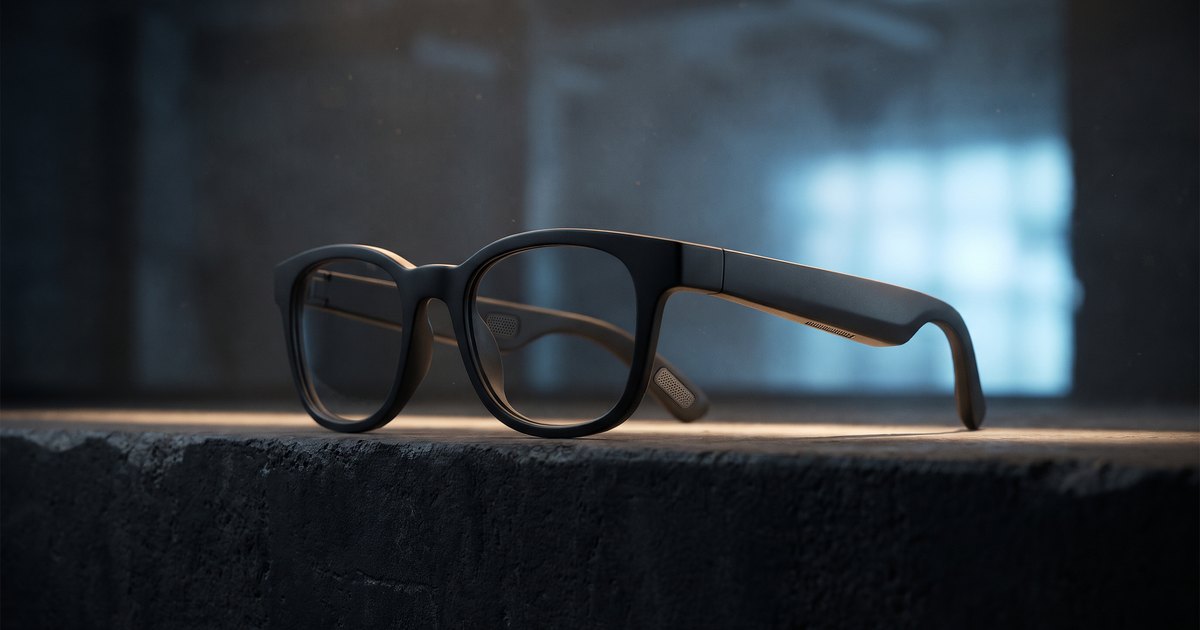
Between January and March this year, the world bought 2.25 million pairs of smart glasses with no display in them. That is a 167% increase on the same quarter a year earlier, and it is very nearly the entire category's volume for all of 2024 compressed into thirteen weeks.
In the same stretch, Meta's Reality Labs (the division that has spent a decade arguing that immersive computing is something you look through) reported a second-quarter operating loss of $4.62 billion against $431 million of revenue. That is wider than the $4.03 billion it lost in the first quarter, and it takes cumulative losses since late 2020 to roughly $88 billion.
Both numbers describe the same industry. Only one of them involves a screen.
The first genuinely mass-market device in extended reality is not a display you wear. It is a microphone and a pair of open-ear speakers with a language model sitting behind them. It has quietly outrun an immersive sector whose entire vocabulary, toolchain and cost base is visual: an interface that sector barely staffs for.
The quarter that outsold a year
IDC's mid-June figures reward a close read. Display-less smart glasses are forecast at 13.6 million units and $5.1 billion of revenue for 2026, rising to 27.3 million units by 2030. Optical see-through display glasses (the transparent overlay the industry has promised for fifteen years) come in at 3 million units this year. Mixed-reality headsets: 3.2 million units, $2.4 billion.
Put plainly, roughly two out of every three devices shipping under the XR banner in 2026 have nothing to show you. Meta holds 69.2% of that display-less segment. Average selling price sits at $376 and is forecast to fall to about $229 by 2030, which is the price curve of a consumer accessory rather than a computing platform.
The wider market has the same shape. IDC counted 14.5 million XR devices shipped in 2025, up 41.6%. It is a healthy headline that conceals a 42.8% collapse in MR and VR headsets set against 211.2% growth across everything else.
Every platform is converging on the ear
On 23 June, Meta launched its first self-branded eyewear with EssilorLuxottica: Meta Glasses, from $299, twenty-six styles at launch, open-ear speakers, a multi-microphone array with wind-noise reduction, and its Muse Spark model aboard from day one. There is no display. Pedestrian navigation, the company notes, is "coming soon for displayless glasses."
Apple, according to reporting from Bloomberg and Reuters relayed through the analyst chain, shelved the cheaper Vision Air headset to prioritise lightweight AI glasses that explicitly do not have transparent AR displays. What they do have: cameras, audio, live translation, environmental sensing. Announcement this year, launch expected 2027; glasses with colour displays are not on the roadmap until 2028.
Samsung told its July earnings call it would ship "Intelligent eyewear" later this year, developed with Google on Android XR. Note the noun. Not glasses, not headset, not XR: a category name chosen to avoid every word the industry has been using, in the same quarter the company posted the first loss its mobile division has ever recorded.
Three companies, three strategies, one convergent bet: the thing people will actually wear on their face all day is a listening device.
"The medium arrived on schedule. It just came through the ear, and most of us were watching the eye."
The venues knew first
Anyone who has commissioned a large physical installation will find none of this surprising. The high end of immersive has been audio-led for years, quietly, while the coverage went to the pixels.
The Sphere in Las Vegas runs 167,000 individually amplified speaker drivers behind its interior surfaces, using Holoplot's beamforming matrix arrays. At Lightroom in King's Cross, David Bowie: You're Not Alone ran from 22 April to 28 June on two Holoplot X1 Matrix Arrays (four Modul 96s and four Modul 80-Ss apiece) recessed into the wall cavities, with the show's tracks re-authored for the room by sound designer Gareth Fry. Festival-scale object-based rigs now run past 170 loudspeakers in a single L-ISA deployment.
Nobody has ever sold a ticket to a wavefield synthesis array. They sell the feeling it produces. Audiences almost always describe that feeling in visual language, saying they felt inside something, because English is short of vocabulary for what accurate spatialisation does to a room.
What it costs, from the floor
Three things look different from inside a production studio than they do from a market forecast.
The first is that in hybrid physical-digital work, sound is the cheapest immersion per pound spent. A room's audio layer can be re-authored in days; its structure, surfaces and projection content cannot. When a client wants a second life out of an installation, the audio is where the change is affordable.
The second is that generative AI has collapsed the cost of visual content specifically, and almost nothing else. That asymmetry matters more than the raw saving. If images, textures and 3D assets are trending toward free, the visual layer is the part that commoditises first; the differentiator migrates to what remains expensive and hard to fake: how a space sounds, and how precisely it responds to the person standing in it.
The third is measurement, where the sector remains weakest. Industry budget guidance puts a single interactive station at roughly $20,000 to $50,000 and a room-scale multi-station zone at $40,000 to $150,000 and up, with vendors claiming well-designed interactives lift dwell time two to five times over static display. Treat the multiplier as a supplier's own figure rather than independent research, but note what it measures. Dwell time is precisely the metric a considered spatial audio layer moves, without touching the build, the structure or the schedule.
That is the practical opening. A brand or a museum that cannot justify headset logistics for a thousand visitors a day can justify a soundfield, and increasingly can justify content that follows the visitor out of the building through eyewear they already own: no app install, no hardware to hand out, no queue for a headset wipe.
What to do with it
If the installed base arriving on people's faces this year is audio-first, three things follow for anyone commissioning or building immersive work. Specify object-based audio in the treatment rather than the snagging list, because retrofitting spatialisation costs multiples of designing for it. Bring a sound designer in at concept stage, on the same call as the creative director, not at the mix. And when scoping the take-home layer of a physical experience, assume the device in the audience's pocket or on their nose can hear and speak, and cannot show. That is a constraint, and a considerably cheaper one than the alternative.
The industry spent a decade waiting for the display to get good enough. It may turn out the display was the expensive way to do it.
Scott is the founder of BCVR (https://www.bcvr.io), a London-based immersive experiential production studio working across XR, projection mapping, spatial audio and digital twins for brands and cultural institutions.
Sources
- IDC, "Smart Glasses Market 2026: XR Is Rewriting the Rules," 15 Jun 2026
- VR.org, "Reality Labs Lost $4.62 Billion in Q2," 31 Jul 2026
- IDC, "Global XR Shipments Rebound Behind Glasses-First Momentum," 11 Dec 2025
- Meta Newsroom, "We're Partnering With EssilorLuxottica to Launch Meta Glasses," 23 Jun 2026
- 9to5Google, "Samsung teases Android XR glasses…," 30 Jul 2026
- Gadget Hacks, "Apple Scraps Vision Air for AI Smart Glasses in 2026," Oct 2025 (reporting Bloomberg/Reuters)
- Ticket Fairy, "Immersive Audio in 2026," 21 Jan 2026
- Installation International, "HOLOPLOT spatial audio installed at Lightroom for Bowie exhibition," 19 Feb 2026
- Utsubo, "Interactive Museum Installations: ROI, Costs & Real Examples (2026)"
The House Pair
Camera glasses went on pre-order last week from $395. Cultural venues had already begun banning the visitor's own. The pair that survives is the one the venue hands over.
Two Channels Wide
Generative video finally learned to make sound. It makes it already mixed, and in the same fortnight both dominant post applications shipped tools for pulling finished mixes apart.

Nobody Budgets for RAM
Every XR price forecast assumes someone absorbs component inflation, and the two forecasters you would ask disagree by two years.