
Two Channels Wide
Generative video finally learned to make sound. It makes it already mixed, and in the same fortnight both dominant post applications shipped tools for pulling finished mixes apart.
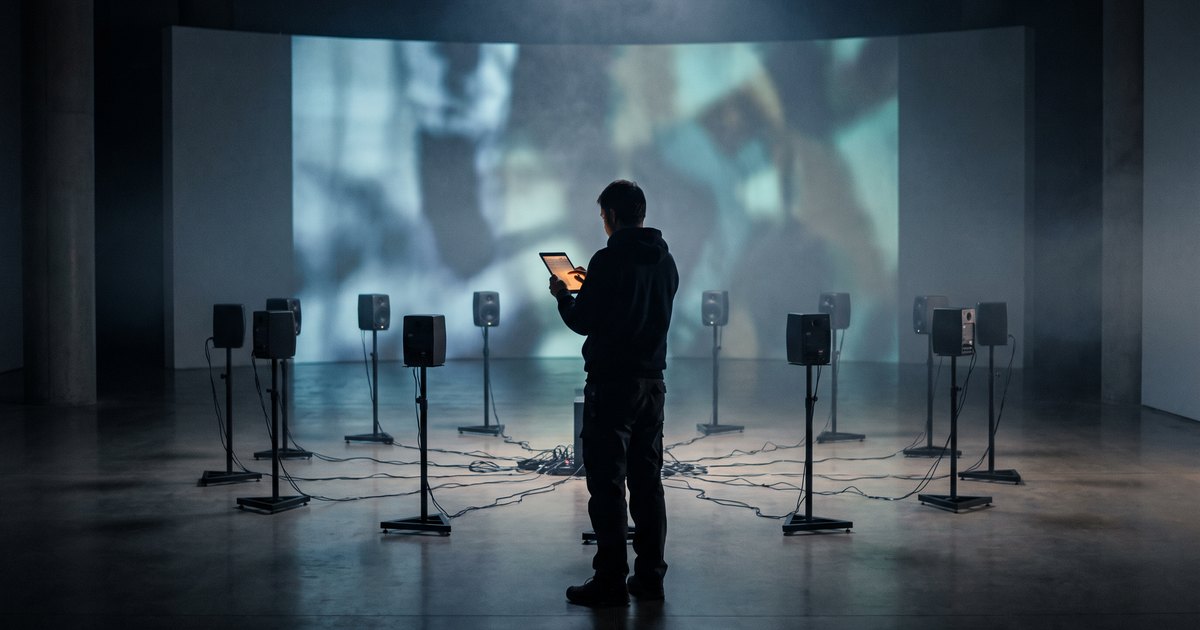
Adobe spent MAX, in Miami Beach from 10 to 12 November, putting generation inside the edit. Its new Generative Media tool drops Generate Video, Generate Sound Effects, Generate Soundscape and Generate Music straight into the Premiere timeline. In the same announcement, with far less fanfare, came tools doing the opposite. Enhance Audio "allows you to separate audio sources and then mix them independently". Separate Crosstalk splits overlapping speakers onto their own tracks. Of ten research previews at Sneaks, exactly one concerned sound, and Project Sound Bender opens with subtraction too: describe a sound, pull it out of a finished mix, then generate variations.
Days earlier, Avid shipped Pro Tools 2026.11 with a Stem Separator Extension. Drag in a file, get back up to six stems, vocals, drums, bass, guitar, keys and other, processed on your own machine.
Separation itself is old news. Spleeter was open sourced in 2019 and Logic Pro has had a Stem Splitter since 2023. What changed this month is placement. Un-mixing became standard equipment in both applications most finished video passes through, in the same release cycle as generated audio.
Generated sound arrives welded
For anyone working in a room rather than on a timeline, the relationship between those two halves is the whole story.
A mix is a decision about a listening position, and generated audio arrives with that decision already taken, because the finished object is the only thing the models were ever asked for. Google's model page sells Veo 3 on "sound effects, ambient noise, and even dialogue", all of it generated natively. The public pages discuss audio as a feature. What they do not discuss, anywhere I could find, is audio as a format: no channel layout, no sample rate, no bed and objects structure. On a timeline that is a non-question. In a building it is the only question.
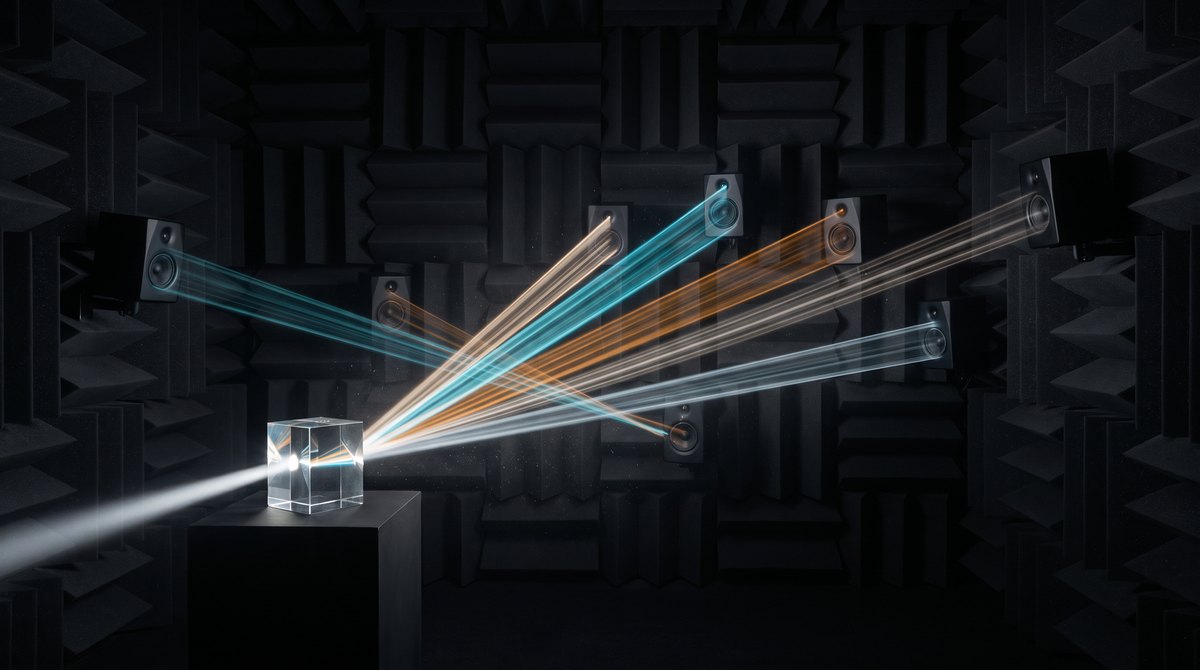
The clearest account of why sits in Apple's own research. StereoFoley, by Tornike Karchkhadze of UC San Diego with six Apple colleagues during an internship there, generates "spatially accurate stereo sound at 48 kHz", placing sounds left and right according to where the object sits in frame. In a listening test of 1,341 ratings from 131 qualified raters, the object aware model scored 3.46 on a five point scale, against 2.93 for the base model and 2.19 for MMAudio, the mono state of the art. One line further down, the real recordings scored 2.97. A generated mix outscoring the original is a result about preference, not fidelity to a place.
A fixed mix can fill a room. It cannot be re-aimed in one, and generated sound arrives with its sources already welded together.
Getting that far took a workaround that tells you where the field is. VGGSound, its standard audio video training set, proved near useless for spatial learning. About 27% of clips are "effectively mono", their channels differing on average by less than one part in a hundred thousand, and the authors estimate under 2% of the corpus shows clear object aware stereo placement at all. So they synthesised the spatial training data instead, captioning scenes with Gemini, segmenting objects, generating generic sounds, panning them by rule. Their conclusion runs to a line: "the main challenge for object-aware stereo audio generation is not architectural but data-related."
The evaluation carries a second confession. Standard metrics are built on mono backbones, so stereo outputs "must be resampled and downmixed to mono, making the metrics largely insensitive to high-frequency content and stereo characteristics." The field cannot yet reliably measure the spatial quality of what it makes.
Spatial generation exists, one rung up
The exception shows the shape of the problem rather than solving it. ImmerseDiffusion, a 2024 paper from the same Apple group led by Mojtaba Heydari, then at the University of Rochester, generates first order ambisonics: four channels, steerable by description or parametrically, through azimuth, elevation, distance, room size and decay time. Its training data was itself synthetically spatialised, thousands of hours built mostly from an existing Freesound corpus. Its best azimuth error is 0.36 against a 0.17 floor the paper calls the lower bound a model could reach. No unit is given, though the circular difference formula implies radians, about 21 degrees if so. First order is the bottom rung of spatial resolution in any case. The paper "focuses exclusively on generating FOA components", generalisable upward "albeit with increased complexity". Four channels around one listening point is a fine deliverable for headphones, not a show file for forty loudspeakers.
One head, in a known position
The most complete attempt to join the halves appeared at UIST in Detroit this month. Sonic Stage, from a team across HKUST, Columbia, Stuttgart and Rochester, reconstructs a dialogue scene in 3D, works out which sounds are missing, generates five candidates each with ElevenLabs' text to sound model, has Gemini rate them, and places the winners in the reconstructed space. The gains are not marginal. Blind and low vision viewers recalled character positions 89% of the time against 44% for the baseline, and movement 86% against 18%.
The honest numbers are the useful ones. Twelve participants, on AirPods Pro, 8.2 minutes of processing per minute of video. The lowest rated of the study's audio measures was diegetic clarity, whether you could tell what the generated sound was, at 5.00 out of 7, standard deviation 1.28 across those twelve people. The system "assumes non-overlapping speech", and the authors note that "when several actions occur in rapid succession or simultaneously, auditory cues may become difficult to distinguish." Generated spatial audio presumes one head whose position is known. A gallery has neither.
Vendors are edging toward rooms regardless. ElevenLabs made its third generation sound effects model the default across its creative tools on 2 November, with a flag for effects that loop smoothly, and a looping effect is an installation feature rather than an advertising one. A week later its Unity agents SDK arrived, playing a voice through an AudioSource you position in the scene "for spatial audio". The spatialisation is delegated to the game engine, as it usually is.
In fairness, separating sound by position is not unsolved in general. Beamforming and direction of arrival separation are decades old, and Zylia's ambisonic Beamformer plugin costs 149 euros. But those tools separate a captured sound field, recorded by an array that knew where it was. They do nothing for a two channel file a model made ten seconds ago. Pro Tools has carried MPEG-H mixing with an Immersive Panner since April 2026. This month it got a separator. The separator hands you a guitar; the panner wants a coordinate. Nothing joins them, and until something does, the join is a person.
What it costs on a real job
At BCVR, my studio, the reading is unromantic. Generative tools collapsed the cost of material and left the cost of placement where it was. On a hybrid physical and digital install the artefact we invoice is not the sound. It is a positioned cue list that survives a venue change, degrades gracefully when a driver fails at 11am on a Saturday, and can be re-aimed in a room whose drawings were wrong. Generation saves the library search, not the mix. Budget the de-mix rather than the generate, and the estimate stops drifting.
Which points at the asset hardly anyone is making. If under 2% of the field's standard training set holds cleanly placed sources, then dry, single source, position logged recordings of real things in real rooms are at once show grade and training grade material, and they are thrown away daily. Record dry, log the position, keep the stems. A mix can always be made later. It can never be unmade.
Sources
- Adobe Blog, Creative Cloud and Firefly announcements, 10 November 2026
- Adobe MAX Sneaks 2026, 11 November 2026
- Jenny Priestley, Pro Tools Stem Separator Extension, TVTechnology, 6 November 2026
- Production Expert, Pro Tools 2026.11, 3 November 2026
- Avid, What's New in Pro Tools
- Google DeepMind, Veo model page
- StereoFoley, arXiv:2509.18272
- ImmerseDiffusion, arXiv:2410.14945
- Sonic Stage, UIST 2026, arXiv:2607.20835
- ElevenLabs changelog, 2 November 2026
- ElevenLabs changelog, 9 November 2026
- Zylia Beamformer plugin
The Scan Is the Prompt
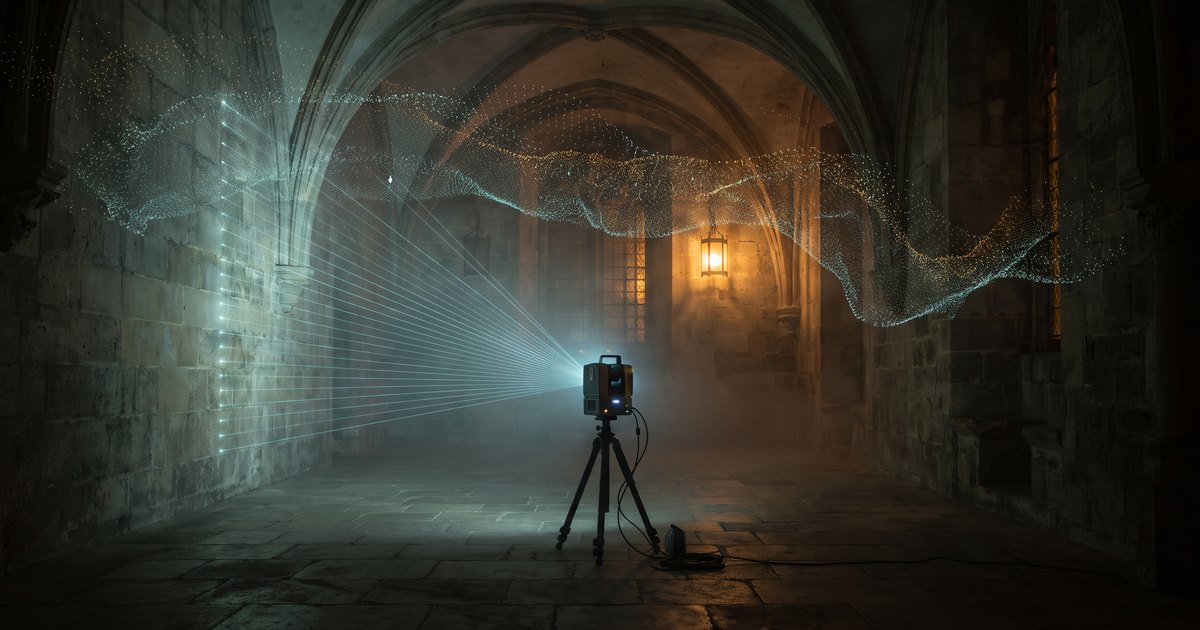
World models will invent everything you do not give them. On an installation, the one thing you cannot let them invent is the building.
The Clip Is Free, the Minute Costs a Million
OpenAI switches off the Sora API next month. Google's video models run a 16K screen that has taken over $400m. Generative video did not fail or win: it stopped being a product.
The Interface with No Screen
The fastest-growing device in extended reality doesn't show you anything. For everyone building immersive work, that changes the brief.