
The Scan Is the Prompt
World models will invent everything you do not give them. On an installation, the one thing you cannot let them invent is the building.
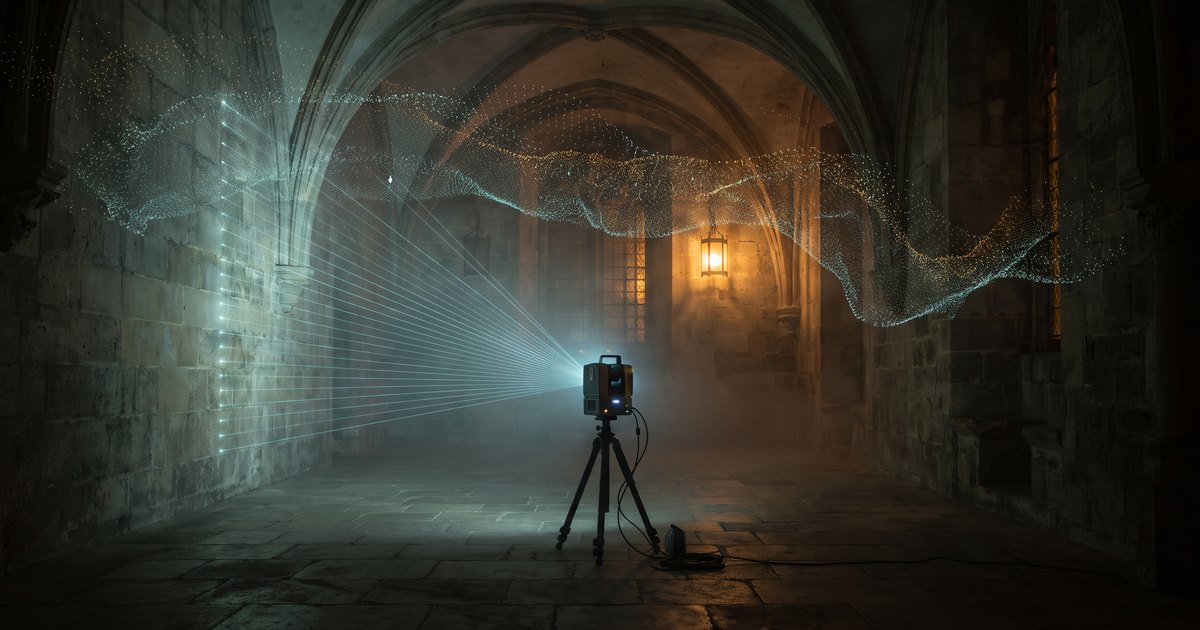
World Labs released Marble last November: explorable 3D worlds built from text, images, video or coarse 3D layouts, exported as Gaussian splats, meshes or video, and the first generative world tool many production teams could plausibly put in a pipeline. The line worth reading twice is not a boast but a description of how prompting works. Text and image prompts, the company writes, are "intuitive and powerful, but limited in creative control: Marble must invent all the details of the world that are not present in the input text or image prompt." Often magical, it adds; sometimes not what you want, which is precisely why the product also accepts a coarse 3D layout as an input.
That last option is the argument of this piece, arriving early and from the vendor: the way you stop a world model inventing your building is to hand it the building.
Google DeepMind is equally explicit about Genie 3, its navigable world model running at 720p and 24 frames per second. Its published limitations include interaction duration ("a few minutes of continuous interaction, rather than extended hours"), environments "largely consistent for several minutes" with visual memory reaching about a minute back, and an inability to "simulate real-world locations with perfect geographic accuracy."
Set that against a typical installation brief: one specific real building, at exact geometry, running for months. Generative models are fluent about surfaces and agnostic about coordinates. The question was never whether AI can generate your content (it plainly can) but what you feed it so it stops inventing your venue.
That is the job a digital twin has quietly taken on. Not visualisation. Ground truth.
What the model will not give you
Three things a generative system will not supply for a physical build, and a survey will.
The first is geographic truth. DeepMind's caveat is the tell: the model produces a convincing room, but not your room. A projection surface that is convincingly wrong is worse than a blank one, because it will not line up with a column that exists.
The second is repeatability, and it is worth being precise. For most installations the model's session ceiling is beside the point: content is rendered once and played back. The real constraint is that generative output is not reproducible on demand. Ask in month four for the same shot with one element changed, and a pipeline that cannot regenerate against fixed geometry returns something subtly different. On a projection surface, that means a realignment. Venues running models live inherit the session limit directly, and it is short.
The third is tolerance, and here I am reporting from practice rather than citing anyone, because it is not the kind of thing a model card measures. A generated frame carries no obligation to be right to within a few millimetres of a real edge. A projection map does. Every frame in an installation is ultimately a claim about where a physical surface is.
A generative model is fluent about surfaces and completely agnostic about coordinates. A building is a coordinate problem.
The capture layer grew up
The useful development of the last eighteen months is not generative at all. It is that measuring a room got cheap.
Gaussian splatting is the reason. AWE's own write-up ahead of its 2026 US event called it "the biggest story in reality capture," noting that a replica of a complex space that once "took weeks of processing and massive computing power" can now be captured in startling detail and viewed in real time on standard hardware. The conference put a Digital Twin track and a Reality Capture Pavilion on the floor and added an Auggie award category for reality capture: the unglamorous signal that a technology has become infrastructure. The 3D mapping and modelling market is forecast to run from $17.63bn in 2026 to $29.20bn by 2031, a 10.6% compound rate, with mapping hardware still the largest slice.
It is worth being honest about what splats are not. The Portuguese commercial capture studio Amplified Creations (which sells this work, and whose recommended hybrid workflow happens to be the one argued for below) puts it well in a field report: "a splat is a cloud of colour, not a structured model." Excellent for looking at, poor for measuring, heavy to deliver, largely uneditable after capture, and unforgiving of bad input, which leaves floaters that are hard to fix afterwards. Which is why the serious version of this work is hybrid: laser survey for the geometry you build against, photogrammetry or splats for appearance, and the discipline to know which you are trusting for which decision.
The most complete example remains the Vatican's. Iconem spent three weeks scanning St Peter's Basilica with drones, cameras and lasers, gathering more than 400,000 high-resolution images; Microsoft's AI for Good Lab refined the result to millimetre-level accuracy, then ran AI over it to detect cracks and missing mosaic tiles. That twin became two immersive public exhibits and an interactive site, launched in November 2024 ahead of the Jubilee. Note the order of operations: the building was measured first, and the AI worked on the measurement.
The survey is the first creative act
At BCVR the change we have felt most is not in the render farm. It is that the site survey stopped being a technical formality and became the moment the project actually gets decided.
Once you hold a good capture, a surprising number of arguments resolve themselves. Sightlines stop being opinion. You find out in week one, not on site, that the column nobody mentioned bisects the hero shot. Content is authored against the real surface rather than a drawing of it: the difference between a two-day alignment on site and a two-week one. And the same capture that carries the projector map also carries the acoustic model: if audio placement is where the emotional work happens, one measured model of the room feeding both visual and sonic design is the cheapest coordination a project will ever buy.
There is a governance benefit too, dull until it saves you. A generated asset authored against a surveyed twin has a provenance trail: made for these coordinates, from this capture, on this date. When a client's brand-safety review asks what the model was given, "the building" is a better answer than "a prompt."
Capture first, then generate
The practical read here is an order-of-operations argument rather than a technology one.
Scan before you write the creative treatment, not after it is approved. Budget capture as a design cost rather than a survey line, because it is now the input that determines what the generative stage can be trusted to do. Decide which artefact is your measurement of record and which is your reference for appearance, and never let a splat be both. And when a world model offers to build the room for you, remember what its own documentation says it does with everything you did not give it.
The models have become very good at imagining spaces. The advantage belongs to whoever has actually measured one.
Scott Marshall is founder of BCVR (https://www.bcvr.io), a London-based immersive production studio working across XR, projection mapping, spatial audio and digital twins for brand and cultural clients.
Sources
- World Labs, Marble, 12 November 2025
- Google DeepMind, "Genie 3: A new frontier for world models", 5 August 2025
- AWE, "The Spatial Enterprise: Digital Twins and Reality Capture at AWE USA 2026", 20 March 2026
- MarketsandMarkets via GlobeNewswire, 23 July 2026
- Amplified Creations, "Is 3D Gaussian splatting production-ready in 2026? An honest field report", 4 July 2026
- Microsoft Unlocked, "La Basilica di San Pietro", November 2024
The Clip Is Free, the Minute Costs a Million
OpenAI switches off the Sora API next month. Google's video models run a 16K screen that has taken over $400m. Generative video did not fail or win: it stopped being a product.
The House Pair
Camera glasses went on pre-order last week from $395. Cultural venues had already begun banning the visitor's own. The pair that survives is the one the venue hands over.
Two Channels Wide
Generative video finally learned to make sound. It makes it already mixed, and in the same fortnight both dominant post applications shipped tools for pulling finished mixes apart.