
The Map Has a Shelf Life
Headset shows depend on a stored map of their room. The survey twin gets a handover and a sign-off. The map the headsets use often gets redone by whoever opens up.
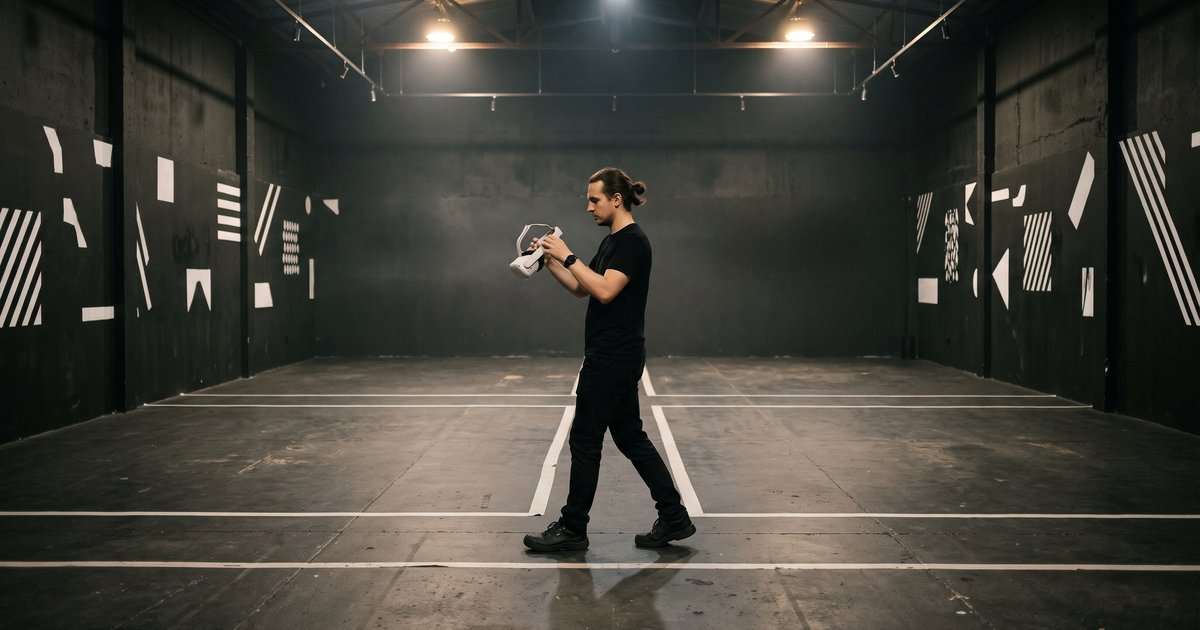
At IAAPA Expo in Orlando last week, the free-roam stands were selling what they had taken away. Zero Latency previewed Jumanji: The Lost Levels, which Arcade Punks reports as its first hands-only game, with "no controllers, buttons or peripherals to learn". The show version put up to six players in an arena of "about 100 square metres", rising to eight when it reaches venues on 4 December. AStation showed Sword on Apple Vision Pro, which Blooloop summarised in one line: "No controllers, tethers, or walls are involved." The Expo drew 39,550 verified attendees.
Neither report says how those shows track their players, and arenas that follow people from fixed cameras are a different case. On the standalone headsets most studios now build for, every removal moves weight onto one thing. The headset works out where it is by looking at the room and recognising it from a map it stored earlier. A group shares one virtual world because their headsets agree on a common reference in that room, whether a shared anchor or a shared map.
That stored map is a twin of a kind. It is sparse, unreadable by people and often impossible to export, but it is a model of one particular building, made by capture, and the show stops without it. On the jobs we see, it is also the one model of the room that nobody signs off.
What the opening shift knows
The plainest account comes from the people who sell tools to arcade operators. Synthesis VR published a guide to mapping and calibration in March. "Every standalone VR headset running free roam uses a tracking method called visual simultaneous localisation and mapping, or vSLAM," it says. That is a vendor's generalisation, but its list of what spoils the map rings true: "Lighting changes, reflective surfaces, uniform walls with few distinguishable features". A smudge on one camera will do it, or "furniture moved near the boundary".
Drift, the guide says, "compounds quietly, session by session, until staff are recalibrating every morning as a matter of routine". Its figures support its own fleet tools and should be read that way: consumer headsets "can require up to 30 minutes of morning calibration per unit", "plus up to 15 additional minutes" of troubleshooting through the day. Its rule is the useful part: "when the physical environment changes, the map needs to be reviewed, not assumed to still be valid."
The platform documentation says similar things in a quieter voice. Meta's colocation guidance, updated on 7 October, tells developers to "Keep shared content within 3 meters of its anchor, because drift grows the further content is from the anchor", and that the play space "must have some unique visual cues". Each Quest keeps its own tracking map and finds the shared anchor against it. The room layout is a separate thing again. Meta's Space Sharing page, updated on 10 November, says "Only the Host device must have a scanned Scene Model before sharing, Guests simply load the shared data." If anchors misalign, the advice is to have the host move the headset between sessions, or to clear the headset's physical space history.
The survey is signed off once. The map the headsets use is often remade by whoever opens up.
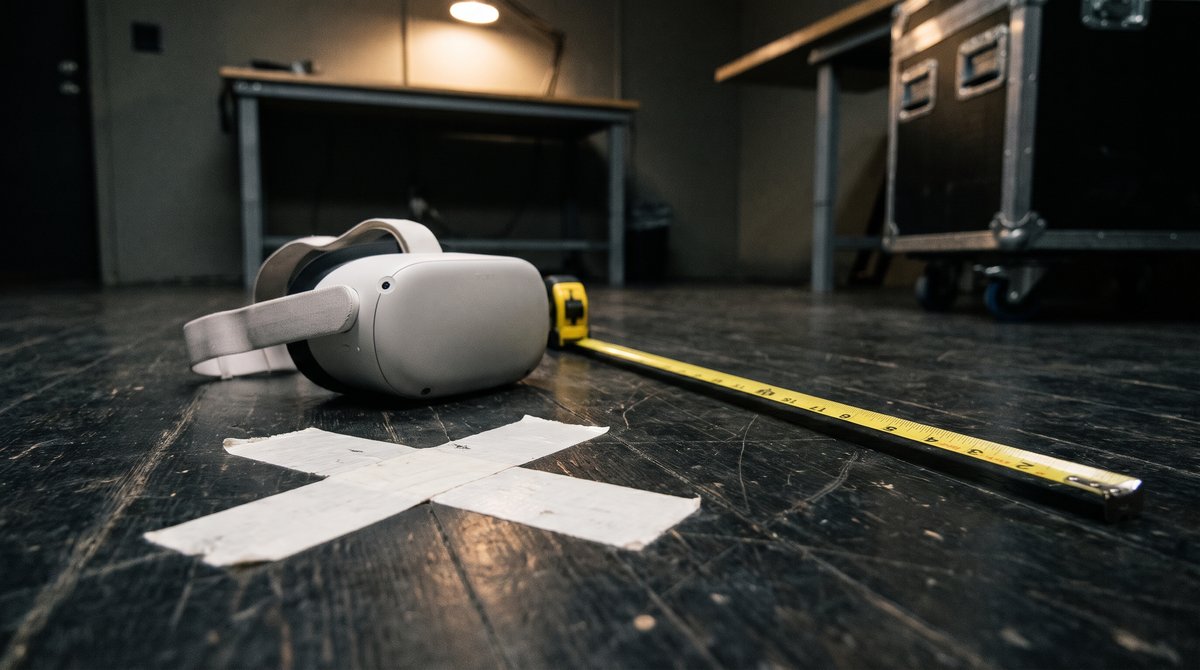
An old result nobody budgets against
None of this is news to computer vision. A paper posted in August 2020 by Johanna Wald of TU Munich, with colleagues at Chalmers, the Czech Technical University, Five AI and Google, introduced RIO10, a benchmark of ten indoor scenes scanned repeatedly over time. Its abstract says: "Our results clearly show that long-term indoor re-localization is an unsolved problem." The conclusion is specific about the cause: "Large semantic changes, e.g. caused by large objects in a scene changing their position, are a particular problem." The benchmark is six years old, and the kind of failure matters more than its scores. A large object changing position is a fair description of a new merchandise wall or a relocated bar.
More recent work points at the remedy. An NYU preprint studies street imagery gathered across most of a year. It concerns image retrieval outdoors, so it is evidence about the principle and says nothing direct about rooms or headset maps. Its authors write that "Static databases become obsolete as these changes accumulate", and that detecting changes and updating the reference set recovers "+30.1 R@1 at the largest time gap", meaning points of retrieval recall. What they describe is upkeep, a process that runs after the capture.
Two models and a cross of tape
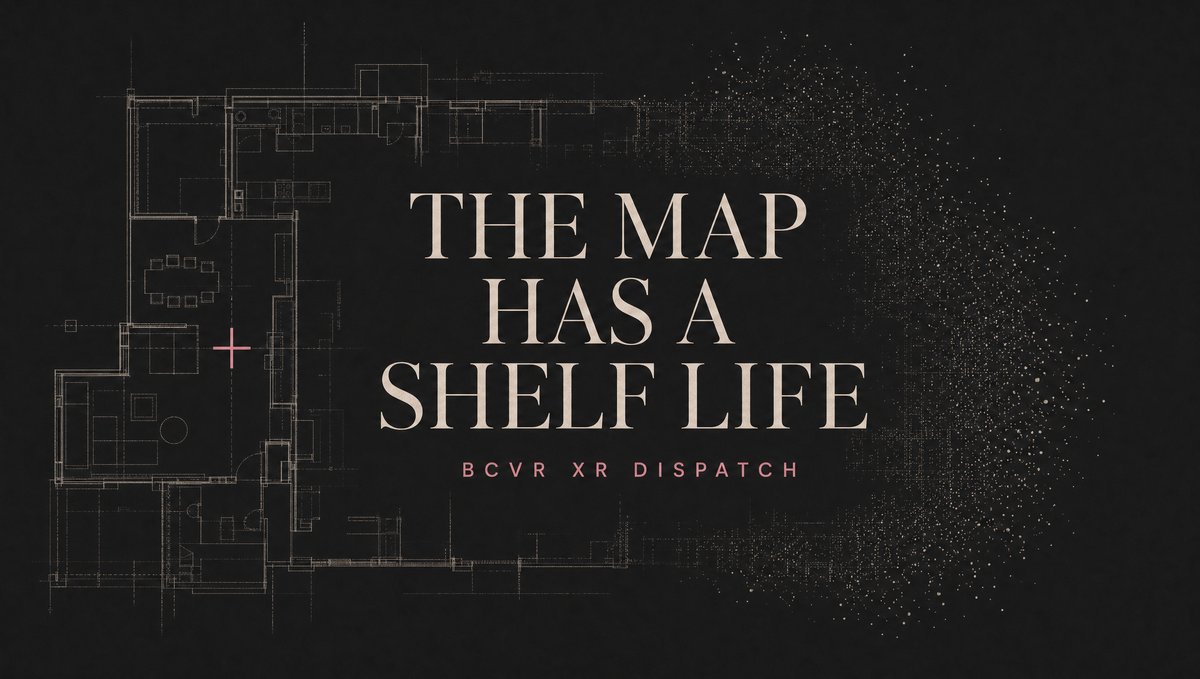
An installation with headsets in it carries two models of the same room. The first is the survey: the scan and drawings used for sightlines, projection and fabrication, delivered and signed off. The second is whatever the headsets hold.
The join between them is usually humble. A recent paper from researchers at the University of York and Qatar University describes a co-located mixed reality prototype tested with fifteen participants on Quest 3. Its headsets register to a shared anchor at a physically marked point in the venue, and its floor plan display is tied to the room by a "lightweight two-point calibration" using that marker and "a surveyed corner". The paper reports "centimetre-scale anchor re-localisation across restarts" and lists among its limitations that "Residual alignment offsets limited spatial precision." That is normal practice, honestly reported.
The industry has not ignored the problem. Synthesis VR pushes one headset's map to a fleet, and notes that HTC documented map sharing for the VIVE Focus 3 for location-based customers. Apple's ARKit can save and share a world map, Google's ARCore has cloud anchors, and Niantic Spatial advertises "a 4D neural map of each place, kept current". Within one vendor's fleet, distribution is largely solved, and Synthesis states the rule that a changed room means a reviewed map. The narrower gap is the record. None of the guides above describes who owns the map, where a change gets logged, or what the handover document says about either.
At BCVR we build hybrid physical and digital installations, and the room is never finished. Our own observation is that cheaper generative content means venues refresh more often, and each refresh changes what the cameras see. The cost can be counted. Synthesis says that for a ten-headset fleet "doing calibration manually on each device is an hour of work", and frames its labour cost around 365 days a year with staff at $20 per hour. By our arithmetic, not the guide's, an hour a day is $7,300 a year. Its upper figure of 30 minutes per unit, with manual sync, would be $36,500.
So we ask for three things in a handover. A named owner for the headset map. A written list of the changes that trigger a review: lighting states, anything moved near the boundary, any new reflective surface. And a count of remaps in the daily show report, the cheapest measure of whether the room is holding still. "Unique visual cues" belongs in the set design brief too, because a beautifully uniform wall gives the cameras little to hold on to.
Jumanji reaches venues on 4 December. That is the week many venues put up their decorations, and a tree in the corner of an arena is a change to the room.
Scott is the founder of BCVR, a London studio producing immersive installations across XR, projection, spatial audio and generative AI.
Sources
- Arcade Punks: Zero Latency Previews Jumanji: The Lost Levels at IAAPA 2026, Its First Hands-Only VR Game (17 Nov 2026)
- Blooloop: AStation presents Sword, a tether-free mixed reality adventure (17 Nov 2026)
- Attractions Daily: IAAPA Expo 2026 highlights: new rides and record attendance (21 Nov 2026)
- Synthesis VR: Free Roam VR Mapping and Calibration: How to Eliminate Drift (24 Mar 2026)
- Meta Horizon developer documentation: Colocation Tips, Tricks, and FAQs (updated 7 Oct 2026)
- Meta Horizon developer documentation: Mixed Reality Utility Kit, Space sharing (updated 10 Nov 2026)
- Wald, Sattler, Golodetz, Cavallari and Tombari: Beyond Controlled Environments: 3D Camera Re-Localization in Changing Indoor Scenes (arXiv 2008.02004)
- Sheng, Gohil et al., New York University: SCD4VPR: Multi-modal Scene Change Detection for Long-term Visual Place Recognition Database Update (arXiv 2604.11402)
- Ran and Al-Suwaidi: Immersive Commons: Designing Ephemeral Spatial Dialogue for Co-Located Mixed Reality Environments (arXiv 2610.36014)
- Niantic Spatial: homepage
Immersion Is an Ear Problem
Controlled studies keep finding that spatial audio buys presence more cheaply than the industry assumes. The budget templates still tend not to have a line for it.
The Deployer in the Room
Immersive work built its case on generative content and audience sensing. On 2 August, both became somebody's legal responsibility, and that somebody is standing on site.
The House Pair
Camera glasses went on pre-order last week from $395. Cultural venues had already begun banning the visitor's own. The pair that survives is the one the venue hands over.